At Millennium, we have a culture of entrepreneurialism. Our ‘Creative Engineer’ series highlights how technologists bring that mindset to their day-to-day work. In the series, they share more about how they incorporate AI into projects by combining practical technical skillsets with curiosity and experimentation.
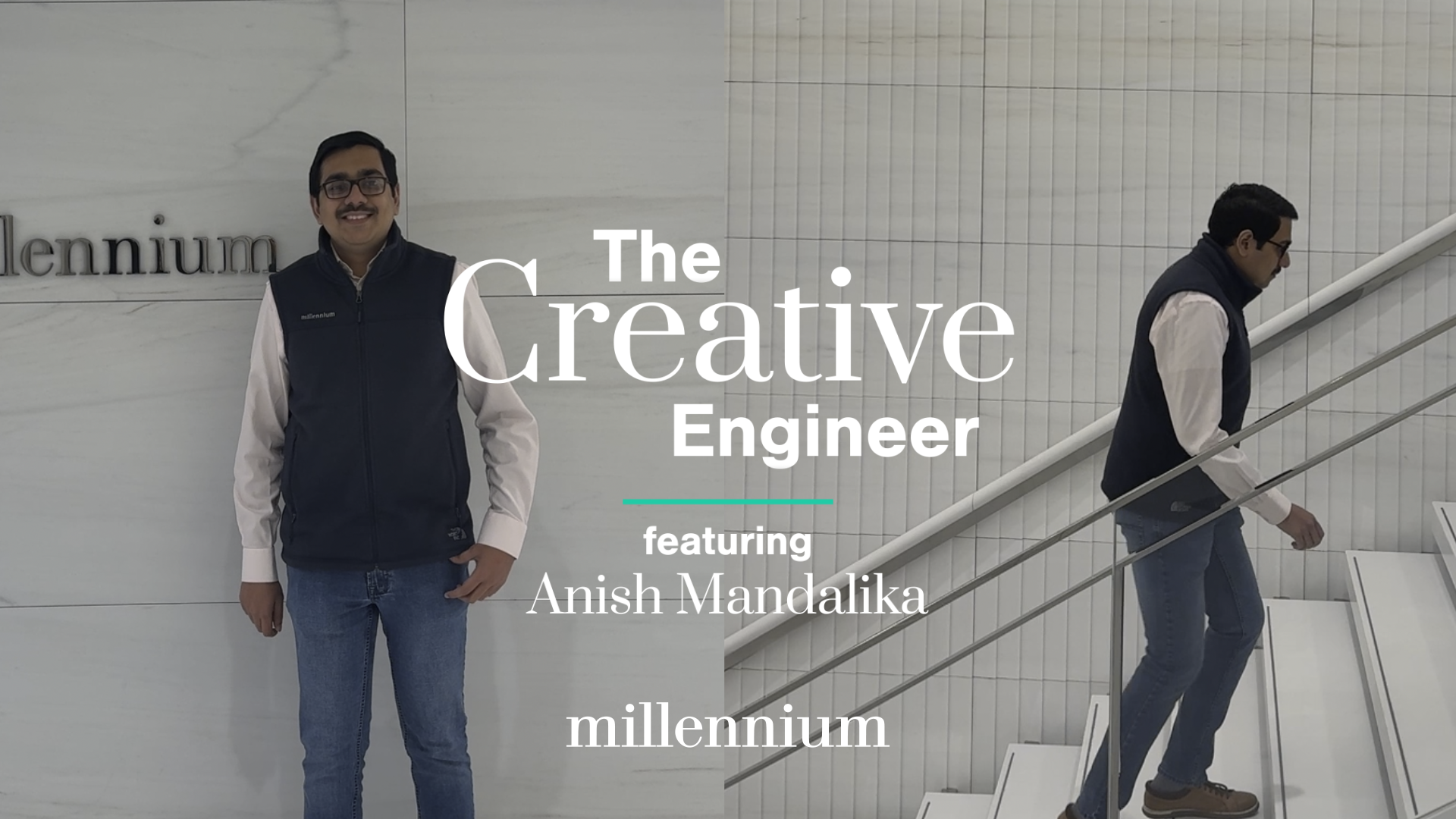
Anish Mandalika, an AI engineer on the Equity AI team, frequently applies creativity to his work. With a hackathon mindset and a focus on optimizing workflows for investment teams, Anish brings both technical expertise and out-of-the-box critical thinking to his work with AI to deliver on business objectives.
Read more about how Anish puts this creativity into practice:
Can you explain your role in one sentence without using the word AI?
I identify and implement solutions to improve the processes of fundamental equity portfolio managers using large language models.
How do you apply creativity in your work as an engineer?
I like to think of my role as a constant hackathon. Being an AI engineer requires creative thinking to identify new opportunities to implement AI solutions and to maximize the impact of the solutions you build.
Part of that is rapid prototyping, but part of it is also being able to take a step back and critically dissect workflows — understanding what is being attempted and why. That’s what lets you build truly novel solutions.
I believe AI’s use extends far beyond the domain of engineering; it’s a highly technical solution with highly non-technical applications and impacts. For that reason, I believe AI engineers have to be doubly creative: AI could help you build better tools, but it can also help reimagine processes or help create tools that were never possible before.
How can AI help change your approach to solving a challenge?
AI lets you fundamentally rethink the scope of a challenge, in my opinion. Rather than just optimizing an existing workflow, it forces you to step back and ask whether the workflow should be approached differently.
Traditionally, you might look at a process and ask “how do I make this faster?” AI lets you ask “do I even need this step?” That shift in mindset — from incremental improvement to reimagining the process entirely — is what I believe makes it transformational.
What’s a common misconception about AI in the finance industry?
I think there’s a misconception that AI has no place in a well-oiled machine. Given the transformational shifts that AI unlocks, I believe there is a place for it in every process — no matter how well-established it is.
In many ways, our thought processes and workflows are informed by the technology available at the time they were built. Recognizing this is what opens the door — when you understand that a workflow wasn’t constructed with AI in mind, you start to see just how big the opportunity really is. It allows you to push the frontiers on what you thought was possible.
What’s one technical skill every future AI engineer should master?
Data and process modeling. If you have a deep understanding of the data and the processes you’re working with, you can really maximize the impact of the AI solutions you design. Once you understand the process inputs, you can better understand where AI can play a meaningful role in enhancing the overall workflow. That foundation is what enables you to build technology that truly solves problems and enables its users.